

Object Record
Images
Metadata
Catalog number |
66.8 |
Artist |
Du Quesnoy, Francois |
Title |
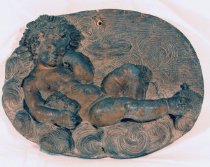
Sleeping Christ Child |
Date |
c. 1618 |
Object Name |
Plaque, Religious |
Description |
Oval terracotta relief plaque with representation of the Christ Child sleeping on a cloud, naked, holding what appears to be a book at his right side, attributed to Francois du Quesnoy (1594-1643), or his workshop, dated to c. 1618. A work of this kind is probably a "bozzetto," a preparatory sketch or model for a work in a more permanent material. This work is attributed to the Flemish sculptor, François Du Quesnoy, born in Brussels. He studied in Rome where the documents name him Francesco or France, and he also worked for the great master, Gian Lorenzo Bernini in rome. Duquesnoy's style is characterized by sweetness and naturalism, qualities of liveliness and subtle modeling. However, these traits are not all reflected in the present bozetto relief. He was a leading sculptor, his style was copied often, and the works attributed to him could be replicas or imitations of his work. If this relief was executed by Duquesnoy himself, it must pertain to his early stay in Rome, ca. 1618. Images of the Infant Jesus carrying the orb became popular only in the seventeenth century. As a result of the Counter Reformation, artists began to render religious motifs in a more naturalistic and expressive mode, so as to touch the heart of the faithful Catholics. In the art of the Coounter Reformation in northern Eurpe, the Infant Jesus is reperesented as the "Amor divinus (Cupid), and the engravings by Anton Wierix name Him "coelistis hec cupido" ("this heavenly Cupid"). In the terracotta bozzetto, showing the Infant Christ Sleeping on the Cross and Dreaming of His Passion, a moving contrast is established by juxtaposing the Child's innocenece with His predestined sacrifice. A bozzetto by Duquesnoy in the Lille Museum in France depicts a Sleeping Putto in a composition very similar to ours, which lacks Duquesnoy's quality of organic unity and imminent movement. Wittkower says of Duquesnoy's putti that they seem to be alive and to breathe, qualities which are lacking in the Queens bozzetto. Research paper by Marilyn Bakst and Bernadette Schalhoub (1978); this extract by Mary Matosian (1979). |
Medium/Material |
Modeled terracotta/Ceramic |
Dimensions |
H-2.559 W-8.268 L-10.787 inches |
Exhibition and Publication History |
*REFORMING THE IMAGE IN NORTHERN EUROPE IN THE DUTCH GOLDEN AGE, Februray 4, 2013 – March 23, 2013, GTM, CUNY, NY * "A Selection From the Queens College Art Collection" , Klapper, 1979, #39 * Student paper in accession file * Exhibited Museum of Archaeology, Staten Island, 1980-81 |
Culture |
Flemish |