

Photo Record
Images
Metadata
Catalog Number |
2015.8.3 |
Photographer |
Cartier-Bresson, Henri |
Title |
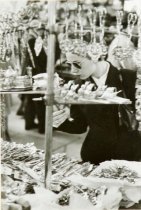
Woman at Portobello |
Date |
1979 |
Object Name |
Print, Photographic |
Description |
Henri Cartier-Bresson (Chanteloup-en-Brie, France, 1908-2004 Montjustin, France) "Woman at Portobello (London Flea Market)," 1979. Gelatin silver print, 10 x 6 ¾ in. Cartier-Bresson is considered the progenitor of modern photojournalism. He attributed the street life he documented, primarily shooting with a Leica and a 50 mm lens, to his early life as an avid hunter. Cartier-Bresson's photos were first exhibited in 1932 at the Julien Levy Gallery in New York, where Man Ray and other Surrealists were first exhibited. He was given work as a fashion photographer for Harper's Bazaar, but was uncomfortable in that environment, preferring to capture life as it happened to posing models in studio arrangements. In 1939, Cartier-Bresson joined the French Army as a Corporal in the Film and Photo Unit. He was captured by German soldiers in 1940 and spent 35 months in a prison camp before finally escaping. Upon his escape, he aided the underground movement, assisting others to escape from the Nazis. At the end of the war, he photographed the Occupation and Liberation of France. In 1952, Cartier-Bresson coined the phrase the "decisive moment" with the publication of a book of the same title. This phrase succinctly summarized the photographer's own mission and direction the framing of an image that expresses the quintessential moment. Cartier-Bresson did this with a fast lens and fast film, composing photos in the viewfinder, shooting series from which he would choose the optimum image, working undetected and without a flash, never cropping in post-production, and working exclusively in black and white. This image, of a woman shopping in the London flea market, captures the essence of Cartier-Bresson's work. He recognized the precise moment when the elements of the picture aligned and the composed image was created. This photograph was taken in 1966, after Cartier-Bresson withdrew from the photo agency Magnum to concentrate on portraiture and landscape photography. |