

Object Record
Images
Metadata
Catalog number |
98.4.10 |
Artist |
Unknown |
Title |
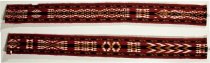
Pair of tent band fragments |
Date |
Late 19th Cent |
Object Name |
Art, Textile |
Description |
Two tent band fragments from Qataghan Uzbek tribe in Northeastern Afghanistan from the late 19th century. The bands are wool flat weave in red, black, brown, and white with decoration that depicts jewelry designs. "The begs, or nobility, of the Qataghan Uzbek were the de facto rulers of large tracts of present-day Afghanistan, dominating settled Turk and Tajik peoples through a loose system of chiefdoms under the beg of Kunduz" Kate Fitz Gibon and Andrew Hale, "Uzbek Embroidery in the Nomadic Tradition," 2007. "During the nineteenth century, the largest tribes of Dasht-i-Kipchak Uzbek origin were the Durmen, Kungrat, and Lakai; splinter groups included the Marka, the Turkman of the Yuz, the Kesamir, the Qataghan, the Naiman, and the Semiz. These tribes have a common history of nomadic pastoralism and similar social structure, rituals, and beliefs. Many aspects of their material culture are so similar as to be indistinguishable. Each group developed economic specialties suited to its local environment, and each retained a distinct tribal identity that was expressed in the details of cultural life – in costume, household decoration, and artistic style." p. 50 Uzbek Embroidery, Andrew Hale |
Medium/Material |
Wool |
Dimensions |
W-6 L-72 inches |
Year Range from |
1800 |
Year Range to |
1900 |
Exhibition and Publication History |
*"Interwoven Worlds: Exploring Domestic and Nomadic Life in Turkey," GTM at Flushing Town Hall, March 9-April 29, 2012. A. Winter and A. Bauer, Curators. |
Culture |
Qataghan Tribe/Uzbek/Afghanistan |