

Object Record
Images
Metadata
Catalog number |
P143 |
Artist |
Altdorfer, Albrecht |
Title |
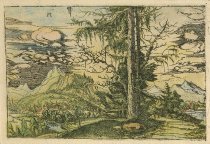
Fig-tree in a Mountainous Landscape |
Date |
16th Century |
Object Name |
Etching |
Description |
This hand-colored landscape etching is a facsimile of a print by the German artist Albrecht Altdorfer. The landscape has not been identified with any specific location, but it does achieve illusionistic space. There are clear and subtle distinctions between natural elements in the foreground, middleground, and background. Suggestions of people are found on the embankment, but are not central to the work. Attention to weather is noted in the specific shapes and implied movement of the clouds. The idea of depicting actual landscapes emerged in the 15th and 16th centuries: Altdorfer's prints are early examples of landscape as subject matter for its own sake. Medieval representations of landscape show little illusionistic space or realistic depiction of natural elements, and scale is based on importance of subject rather than spatial location or perspective. People were limited in their daily lives by the forces of nature, such as cold winters, due to the lack of technology. The development of landscape in the Renaissance resulted from a variety of contemporaneous inventions. One such example is Leon Battista Alberti's Treatise De pictura (1435-36), which demonstrated how to create the illusion of real space on a two-dimensional surface through a system of linear perspective inspired by Masaccio and Brunelleschi. The ability to control nature through a mathematical formula gave the Renaissance artist a powerful tool. The world could be seen through the eye of the individual artist rather than as God's creation. Humanists like Petrarch, who championed the individual's curiosity and intellectual exploration, propelled actual explorations of uncharted land. This new urge to study and map the world correlates to the naturalistic developments of landscape seen in Altdorfer's etching. Kimberley Babcock, in "SCHOLARS, EXPLORERS, PRIESTS, How the Renaissance Gave Us the Modern World," ex. cat. G -T M, Queens College, CUNY, February 2 - March 27, 2010, 28. |
Medium/Material |
Ink on paper |
Dimensions |
H-4.25 W-6.25 inches |
Year Range from |
1520 |
Year Range to |
1523 |
Exhibition and Publication History |
* Ex. cat. "SCHOLARS, EXPLORERS, PRIESTS, How the Renaissance Gave Us the Modern World," Curated by James M. Saslow, G -T M, Queens College, CUNY, February 2 - March 27, 2010, # 28, ill. |
Culture |
German |