

Object Record
Images
Metadata
Catalog number |
92.9.10 |
Artist |
Bologna, Giovanni da |
Artist 2 |
Settignano, Valerio Cioli da |
Title |
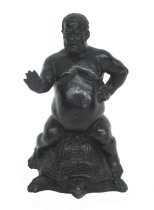
The Dwarf Astride a Tortoise |
Date |
1560-1599 |
Object Name |
Figurine |
Description |
This small bronze of a male dwarf astride a tortoise appears to be based on the marble Fountain of Bacchus, a 1560 sculpture at the Boboli Gardens in Florence, Italy, by the sculptor Valerio Cioli da Settignano. The Boboli Gardens were seen as the validation and commemoration of Medici rule. The prototype was not truly a depiction of Bacchus, but rather a caricature, nicknamed by theFlorentine people. The actual identification of the dwarf is disputed between two historical figures: one named Pietro Barbino and another Morgante, after the giant in a famous Luigi Pulci poem dedicated to the mother of Lorenzo the Magnificent. Giorgio Vasari (1511-1574) claims that Pietro Barbino was a beloved dwarf at the court of Cosimo I de'Medici, admired for his wit, scholastic talents, and benevolence. Vasari states that Cioli made two life-like, life-size and nude sculptures-one of the dwarf Morgante and the other of Barbino. There is skepticism among some scholars that Barbino would have been illustrated as the absurd little man on a tortoise. They suggest that there must be some confusion between the sculpture in question and the other sculpture, which inhabits a niche on the north side of the nearby palace's courtyard. Thought to be the most celebrated sculptor in the latter half of the 16th century, Giovanni da Bologna also had commissions from the Medici family. Much of his work is fountain-based, and he sometimes made numerous clay and bronze models to assist in the progress of his work. Dwarfs depicted in art can have various meanings and connotations. Some Christians saw dwarfs as negatively marked by God and avoided them. Dwarfs were also given comically prominent names by their masters, as in the case of Morgante, who was named after a giant. They were often companions to royal children, as can be seen in Diego Velazquez' (1599-1660) famous painting Las Meninas. Gale Matthews/ Flora Zhen-Ron Kuo, in "SCHOLARS, EXPLORERS, PRIESTS, How the Renaissance Gave Us the Modern World," ex. cat. G -T M, Queens College, CUNY, February 2 - March 27, 2010, 30. |
Medium/Material |
Bronze |
Dimensions |
H-4.75 W-3 D-3.5 inches |
Year Range from |
1560 |
Year Range to |
1599 |
Exhibition and Publication History |
* "From Under Wraps, Recent Acquisitions, 1989 - 1993," Klapper, 1993-94, # 44 * "Director's Choice, Part II," G-TM, 10/10-12/20/02. A. Winter, Curator. * "SCHOLARS, EXPLORERS, PRIESTS, How the Renaissance Gave Us the Modern World," Curated by James M. Saslow, G -T M, Queens College, CUNY, February 2 - March 27, 2010, # 30, ill. Exhibited in GTM: 'Wunderkammer II: Animalia,' 2024-2025 |
Culture |
Italian |