
Object Record
Images
Metadata
Catalog number |
P53 |
Artist |
Ribera, Jusepe de |
Title |
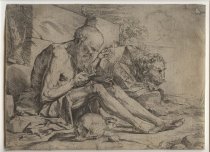
St. Jerome reading |
Date |
17th Century |
Object Name |
Etching |
Description |
This print portrays St. Jerome, a popular Renaissance subject, here seated by a wall reading a scroll with Hebrew writing; alongside are a skull (referring to his meditation on mortality and death), books, a lion (from the legend in which he tamed a lion after removing a thorn from its paw), and a stone (with which he beat his chest in repentance). St Jerome was venerated during the Counter-Reformation for his support of the papacy and is best known today for his translation of the Bible into Latin from the original Hebrew. St. Jerome, who acted as a priestly guide and teacher for friends, was classically educated and studied Hebrew with a converted Jew. The revisiting of Hebrew studies within Christianity owes much to St. Jerome, and his version of the Bible is still recognized by the Roman Catholic Church. As a Spaniard working in Naples, Jusepe de Ribera (1588-1652) was portraying St. Jerome in a center of innovation at the time. While Naples was faced with social and political decline, simultaneously there were reforms, new literary and artistic ideas, and new scientific inquiry; intellectual life intensified political questioning and struggle. These scholarly explorations of new ideas help explain Ribera's unique depiction of St. Jerome. Artists learned to revere Jerome for his scholarship and for his acceptance of other means of illumination by seeking new perspectives and sources of information. Ribera is recognized for his naturalism and expressiveness in the treatment of Christian subjects, which included heroes and martyrs. He chose to depict the devotional image of St. Jerome with a realism similar to that in his portraits from life. There is also a degree of classical antiquity in his then-"modern" work: unlike the usual depictions of St. Jerome during the Counter-Reformation, this image shows his humanity rather than his closeness to God. Ironically, Ribera's tribute to a pillar of Catholic orthodoxy and his ideals of wide-ranging inquiry highlight the increasing acknowledgment of a pluralistic society. Elizabeth Lamourt, in "SCHOLARS, EXPLORERS, PRIESTS, How the Renaissance Gave Us the Modern World," ex. cat. G -T M, Queens College, CUNY, February 2 - March 27, 2010. |
Medium/Material |
Ink on paper |
Dimensions |
H-7.25 W-9.75 inches |
Year Range from |
1600 |
Year Range to |
1652 |
Culture |
Spanish |